Moment and series
A momentary level cannot establish a trend. Comparison requires continuity.
CAS-018 / Bay & old town
Marégrafo de Cascais
Passeio Rainha Dona Maria Pia, 2750-411 Cascais
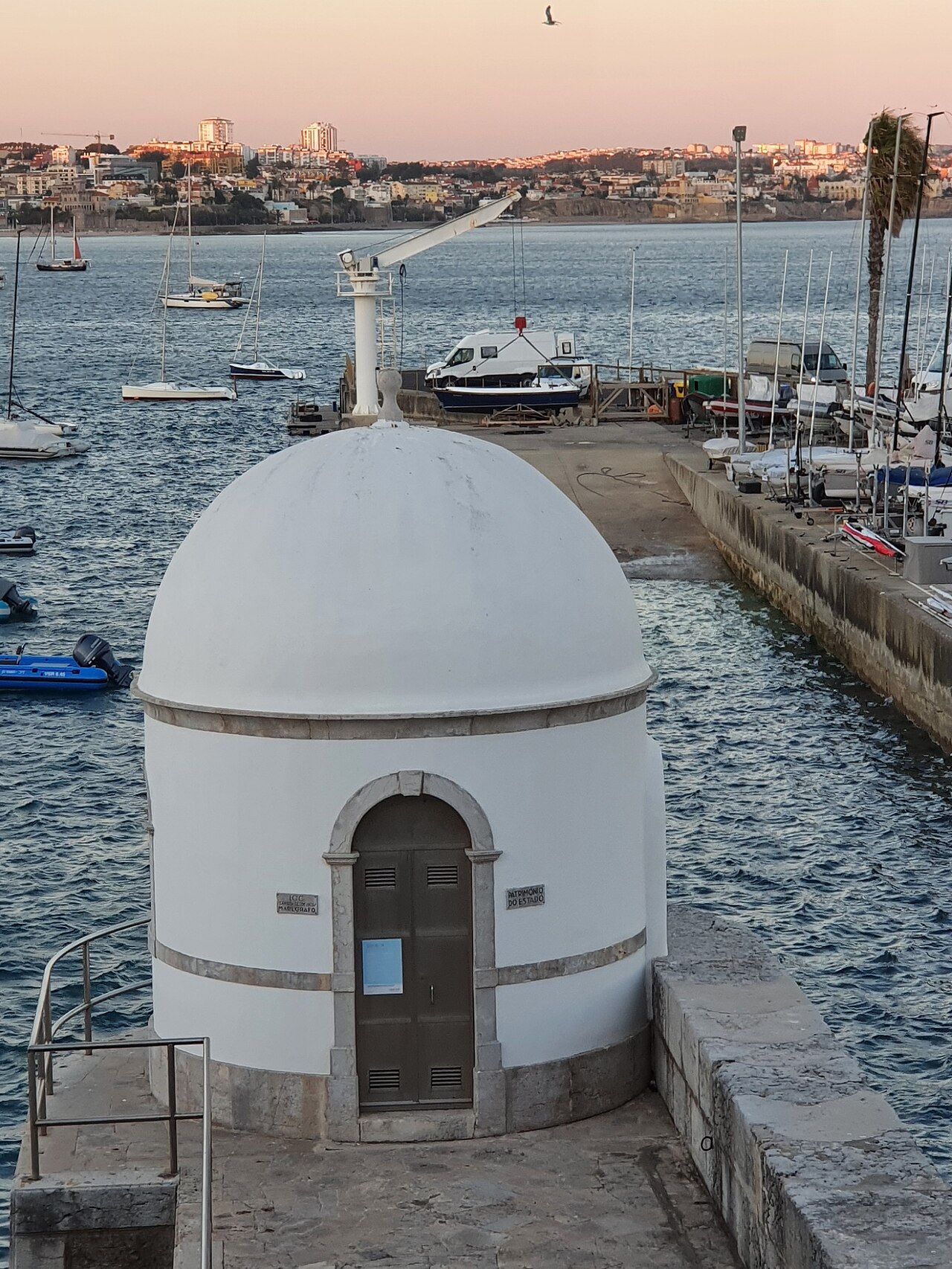
01 / Building stories
Installed in 1882, the tide gauge moved about 30 metres to its present position in 1900. A float in a well, linked to measuring and recording mechanisms, follows sea-level changes. Its observations were fundamental to Portugal’s height reference system.
From the public path, notice building and water. The eye sees a moment; the record makes many moments comparable.
Documentary source ↓02 / I Ching reflections
A shared measure makes change discussable.
Above · Kan · Water
Below · Dui · Lake
Read the six lines from bottom to top ↑
Zhou Yi · Commentary on the Image · Chinese excerpt
泽上有水,节。Water is above the lake: Jie. — Editorial translation of the excerpt
Original text and context ↗Capacity has a measure; both excess and shortage affect use. Jie opens rules, capacity and rhythm to discussion: whom do they support, and what room do they leave for different needs?
This excerpt gives the natural image that opens the Commentary on the Image. The full passage relates it to personal conduct or governance in its historical context. Follow the source to read it in full. Applying it to buildings today is Xiaoxiong’s editorial proposal, not a summary of every meaning of the ancient text.
A momentary level cannot establish a trend. Comparison requires continuity.
A common zero allows heights to be compared; the reference needs explanation.
Instrument, position and method make records interpretable.
Take a question to the bench
When we speak of rising sea level, are we using an impression or a sufficiently long record?
Go to the bench and note what I saw →A contemporary cultural interpretation by Xiaoxiong. The diagram and excerpt have a source; the building connection is editorial, not architectural intent, historical I Ching influence or the venue’s position.
03 / Nearby life
Find a table nearby · filters and directions →
Dining map records within three kilometres in a straight line of the reference point. Walls, railways and slopes may lengthen the journey. Check the entrance and whether the business is open.
Checking Bench membership and claim status…
The map may omit businesses. Records do not confirm trading status, menus or bookings. Records with an address are shown by default; you can include the others.
04 / The travellers’ Bench
When we speak of rising sea level, are we using an impression or a sufficiently long record?
Building reference point: 38.694095, -9.418226. Used to find what is nearby; the public entrance is not yet confirmed.
GualdimG · CC BY-SA 4.0 · Original photograph page ↗
Cropped preview; see the original photograph. The photograph does not confirm the venue’s present condition.
Sources consulted: