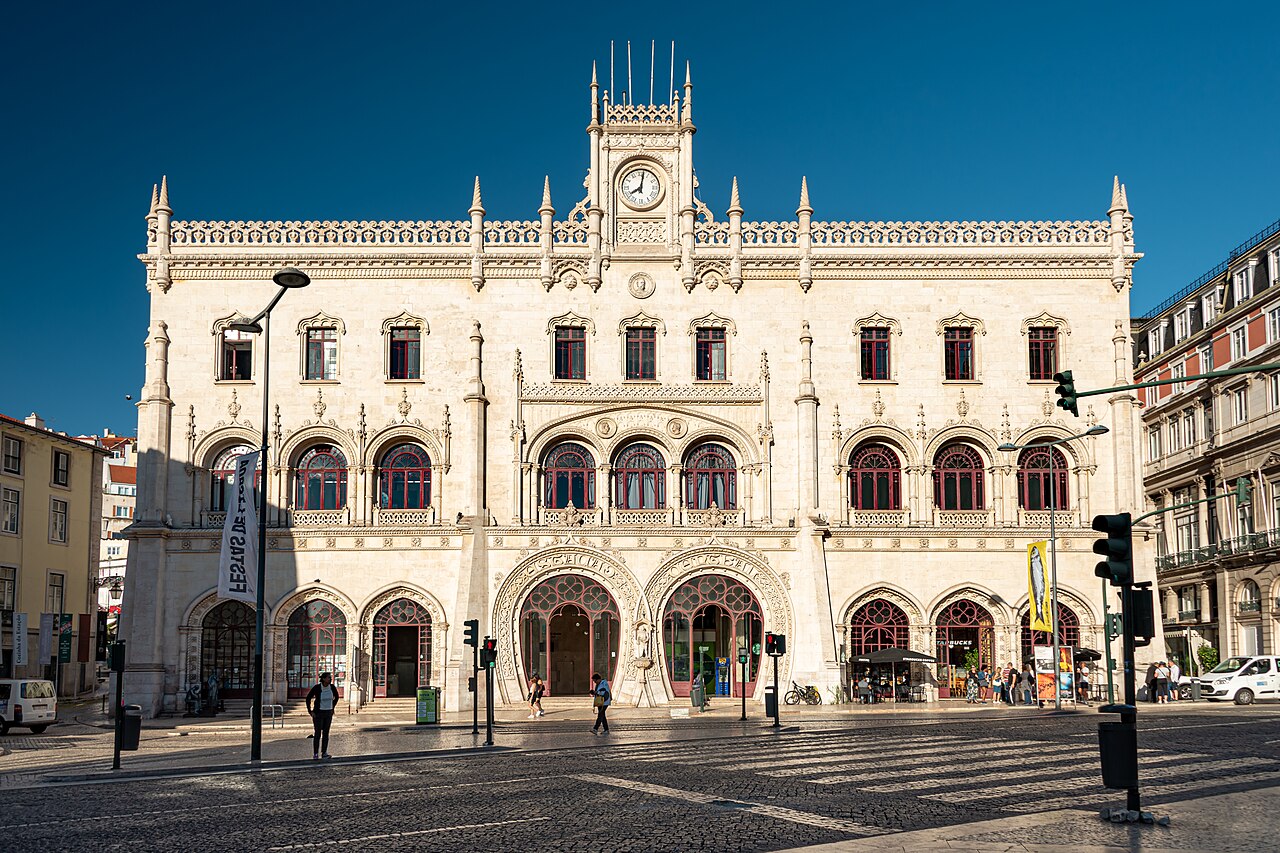
Station and tunnel are built; it opens as Lisbon Central Station.
 XIAOXIONGMARKETLIS-013 / LISBOA
English
Rossio and Restauradores
Rossio Station
The entrance, clock and platforms connect the city with its journeys.
Before entering, confirm opening hours and visiting conditions with the venue.
01 / BUILDING HISTORYFACTS BEFORE INTERPRETATION
Rail crossed the hill
and placed distance beside the square.
Designed by José Luís Monteiro, construction began in 1886 and the station opened on 11 June 1890. Tunnel, hotel, ramps and station form one ensemble; its Neo-Manueline façade and iron roof bring rail into the city centre.
View the full timeline
The royal waiting room, platforms and urban links continue to organise departures and arrivals.
Public-interest listing is followed by a major contemporary intervention.
Historical sources and verification
Historical sourcesOfficial heritage register ↗Official institution · history ↗Wikimedia Commons · licences ↗Supplemental audit source ↗
CITY ANCHOR AUDIT · v1.0
FORMAL ANCHORLIS-013 · FORMAL AUDIT PASSED
Official source
Public heritage, government, archive or responsible-institution records have been checked.
Independent support
At least one separate institutional, professional or academic source corroborates the dossier.
Time and place
Key dates, coordinates and administrative location can be checked against public records.
Facts kept separate
Verified building history is clearly separated from Xiaoxiong's contemporary Eastern reading.
Accountable review
The reviewing team, audit date and next review date are publicly recorded.
02 / WHAT TO LOOK FOR
The entrance, clock and platforms
connect the city with its journeys.
Look at the entrance outlines and clock, then consider how the façade relates to the station's function. Follow signs towards the platforms and leave room for passengers. The square is a good place to begin observing the exterior.
A traveller has no permanent place, yet can pass through without losing measure.
Another perspective on this building
Rossio. The city gives travellers a door and return a line.
Travel is not drifting: the farther we go, the more we need to know how to arrive, stay and leave.
03 / EASTERN EDITORIAL READING · AN EASTERN WAY OF READING THE CITY
HEXAGRAM 56Hexagram 56LüFire over Mountain · Lü
Commentary on the Image
“Fire on the mountain: Lü.”
In passage, clarity and caution prevent excess.
Why do we read this station
through Lü?
Lü concerns the alertness of being away from home. Rossio gives temporary passage a door, a timetable and a destination.
Explore the interpretationXiaoxiong editorial interpretation
Distance enters the centre
The tunnel brings rail to the edge of Rossio and closes the gap between traveller and urban life.
Space · Travel has an entranceThe timetable creates order
Rail turns departure and arrival into time shared with strangers.
Action · Travel has its momentA station receives strangers
Hall, platform and city connection shape urban hospitality.
Public life · Travel has etiquetteKEEP WALKING WITH THIS HEXAGRAMWhen a city receives a traveller,
When a city receives a traveller,
does it offer transport alone or a first moment of understanding?
Step into Rossio and see how luggage, signs, cafés and the square organise arrival together.
FACT AND INTERPRETATION KEPT SEPARATE
Designer, construction, opening, architectural ensemble and listing are verifiable facts. Lü is a contemporary reading about transport, temporary passage and ordered arrival.
Loading the restaurant directory within 3 km…
Rossio Station · 3 KMAround the landmark,
Around the landmark,
— places to try.
Recognize the entrance. Check the route on the map and the menu on the website.