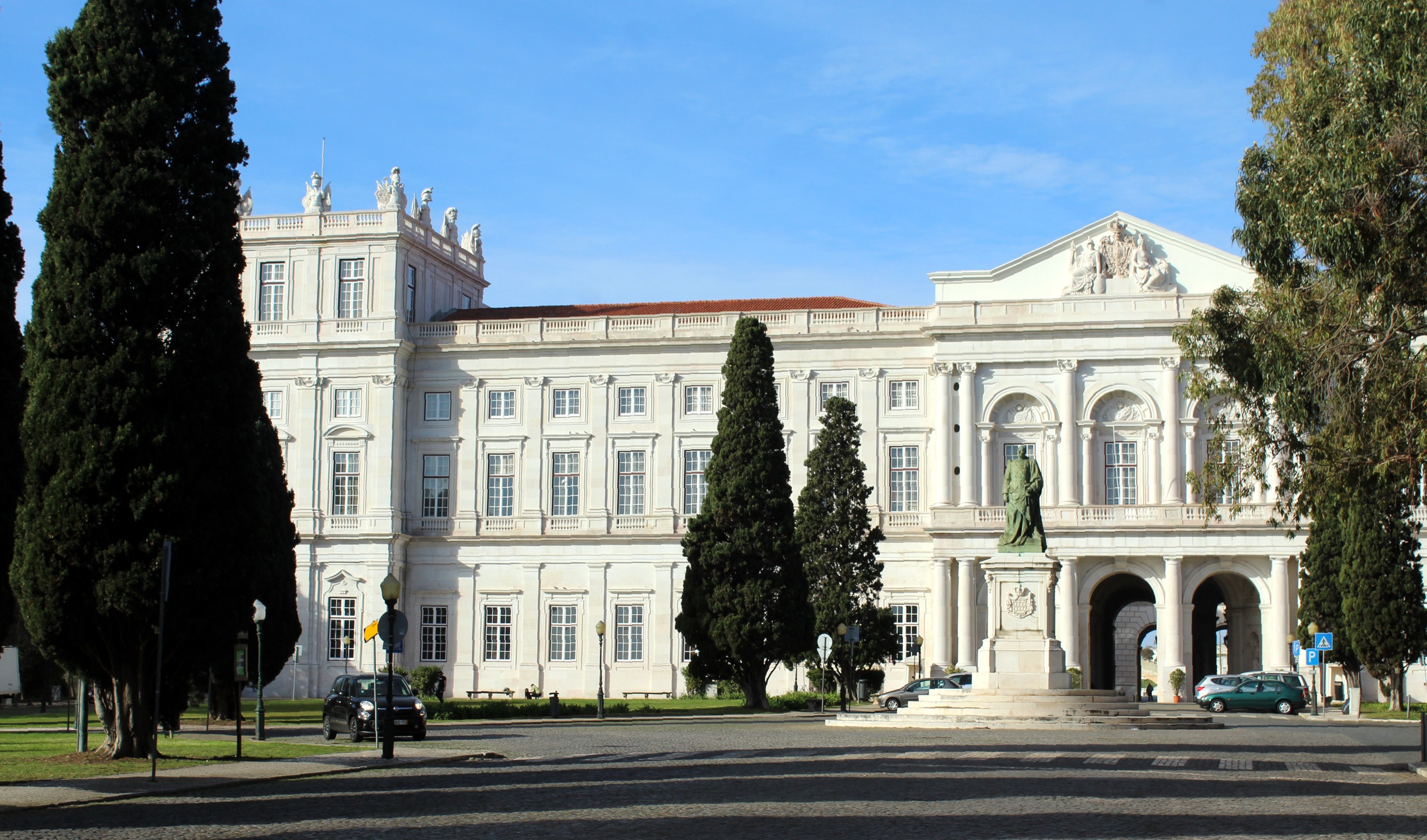
Work begins on the new palace, increasingly shaped by Italian Neoclassicism.
 XIAOXIONGMARKETLIS-023 / LISBOA
English
Ajuda and the Belém hill
Ajuda National Palace
Look at the symmetry and joins between the wings. Find traces of an unfinished palace.
Before entering, confirm opening hours and visiting conditions with the venue.
01 / BUILDING HISTORYFACTS BEFORE INTERPRETATION
War, finance and political change interrupted the work
while court and state kept the building in use.
The stone palace began in 1796 and suffered repeated interruptions during invasion and liberal political change. Occupied from 1826, it became Luís I's principal residence in 1861; today it is a museum and state ceremonial space.
View the full timeline
Invasion, limited funds and politics interrupt and revise the project.
It becomes a royal home, museum and setting for state ceremony.
Historical sources and verification
Historical sourcesOfficial heritage register ↗Official institution · history ↗Wikimedia Commons · licences ↗
CITY ANCHOR AUDIT · v1.0
FORMAL ANCHORLIS-023 · FORMAL AUDIT PASSED
Official source
Public heritage, government, archive or responsible-institution records have been checked.
Independent support
At least one separate institutional, professional or academic source corroborates the dossier.
Time and place
Key dates, coordinates and administrative location can be checked against public records.
Facts kept separate
Verified building history is clearly separated from Xiaoxiong's contemporary Eastern reading.
Accountable review
The reviewing team, audit date and next review date are publicly recorded.
02 / WHAT TO LOOK FOR
Look at the symmetry and joins between the wings.
Find traces of an unfinished palace.
First notice the building's symmetry and gaps, then how its different parts join. Compare the unfinished exterior with the palace's history to recognise traces of interrupted construction. Check interior visiting arrangements separately.
The danger is not remaining unfinished; it is pretending everything is complete.
Another perspective on this building
Ajuda. The palace was not completed as drawn, yet life kept entering.
Wei Ji is not failure; it is admitting that the crossing continues.
03 / EASTERN EDITORIAL READING · AN EASTERN WAY OF READING THE CITY
HEXAGRAM 64Hexagram 64Wei JiFire over Water · Wei Ji
Commentary on the Image
“Fire over water: Wei Ji.”
Distinguish things and place them carefully.
Why do we read this palace
through Wei Ji?
Wei Ji treats completion as a process. Interruption, habitation and reuse show a city moving through unfinished conditions.
Explore the interpretationXiaoxiong editorial interpretation
The plan did not close
Politics and economics left visible absences.
Form · The crossing continuesThe unfinished holds life
The court entered before completion and new functions kept arriving.
Practice · Put things in placeEach generation chooses the next step
Museum and state ceremony add chapters to the old work.
Today · Care through to the endKEEP WALKING WITH THIS HEXAGRAMWhen is a project complete:
When is a project complete:
when the drawing closes, or when it remains useful?
Walk around the palace and let finished surfaces, absences and recent volumes describe both capacity and limit.
FACT AND INTERPRETATION KEPT SEPARATE
The 1796 start, interruptions, occupation from 1826 and royal use after 1861 are official facts. Wei Ji is an editorial reading about process and honest incompletion.
Loading the restaurant directory within 3 km…
Ajuda National Palace · 3 KMAround the landmark,
Around the landmark,
— places to try.
Recognize the entrance. Check the route on the map and the menu on the website.