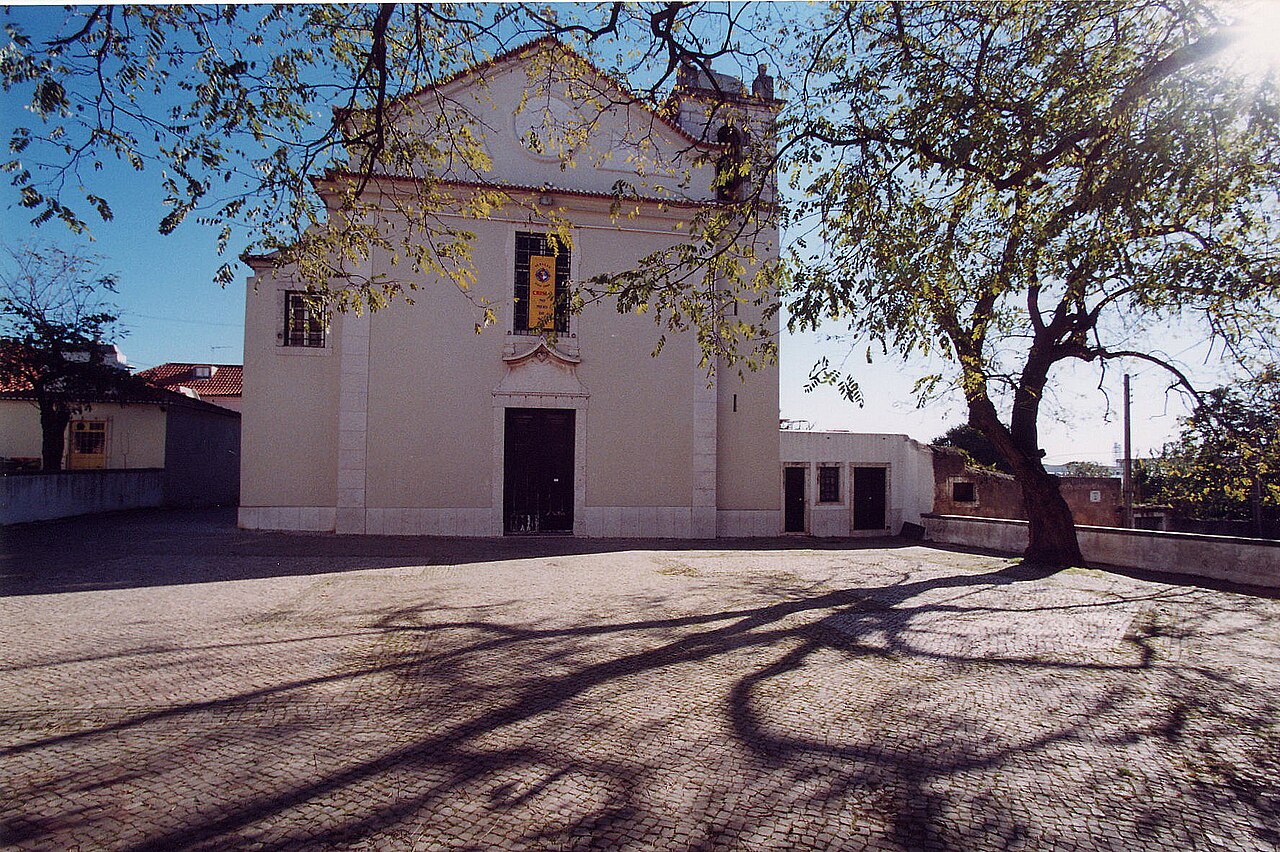
The parish is established and an early church is built.
 XIAOXIONGMARKETLIS-010 / LISBOA
English
Historic centre of Olivais
Church of Santa Maria dos Olivais
Explore the church and its square. Look for the fountain, bandstand and everyday life.
Before entering, confirm opening hours and visiting conditions with the venue.
01 / BUILDING HISTORYFACTS BEFORE INTERPRETATION
The parish predates the modern city,
while church and square hold generations to one place.
The parish was created in 1397 and the church built in the early fifteenth century. After the 1755 earthquake, church and square were reorganised; a fountain and bandstand reinforced the public centre in the nineteenth century.
View the full timeline
The destroyed church is rebuilt and the common square takes a new form.
A fountain and iron bandstand add new infrastructure to collective life.
Historical sources and verification
Historical sourcesOfficial heritage register ↗Official institution · history ↗Wikimedia Commons · licences ↗
CITY ANCHOR AUDIT · v1.0
FORMAL ANCHORLIS-010 · FORMAL AUDIT PASSED
Official source
Public heritage, government, archive or responsible-institution records have been checked.
Independent support
At least one separate institutional, professional or academic source corroborates the dossier.
Time and place
Key dates, coordinates and administrative location can be checked against public records.
Facts kept separate
Verified building history is clearly separated from Xiaoxiong's contemporary Eastern reading.
Accountable review
The reviewing team, audit date and next review date are publicly recorded.
02 / WHAT TO LOOK FOR
Explore the church and its square.
Look for the fountain, bandstand and everyday life.
Look at the church from the square, then find the fountain and bandstand. Notice where people pass, pause and talk: these are clues to the church's relationship with everyday life around it.
A well matters not because it is old, but because it still gives water.
Another perspective on this building
Olivais. The city grows, yet the common well still needs care.
A district may change shape, but shared life still needs a centre to return to.
03 / EASTERN EDITORIAL READING · AN EASTERN WAY OF READING THE CITY
HEXAGRAM 48Hexagram 48JingWater over Wind · Jing
Commentary on the Image
“Water above wood: Jing.”
A common centre calls for work and mutual help.
Why do we read this historic centre
through Jing?
Jing represents a stable public resource. Parish, church, fountain and square create a centre to which people repeatedly return.
Explore the interpretationXiaoxiong editorial interpretation
The centre stays
Expansion changes the surroundings, while church and square keep marking the historic core.
Space · The well does not moveInfrastructure keeps a centre alive
Fountain, bandstand and streets turn a symbol into practical public life.
Community · Draw and assistRebuilding preserves shared memory
Post-1755 work allowed the centre to keep serving without pretending nothing changed.
Time · Repair continuouslyKEEP WALKING WITH THIS HEXAGRAMAs a city expands outwards,
As a city expands outwards,
what still tells neighbours that they belong here?
Circle the square and see how church, fountain, bandstand and everyday pauses define a centre together.
FACT AND INTERPRETATION KEPT SEPARATE
The parish foundation, building dates, reconstruction and public facilities are verifiable facts. Jing is a contemporary reading about a common centre and continued use.
Loading the restaurant directory within 3 km…
Church of Santa Maria dos Olivais · 3 KMAround the landmark,
Around the landmark,
— places to try.
Recognize the entrance. Check the route on the map and the menu on the website.