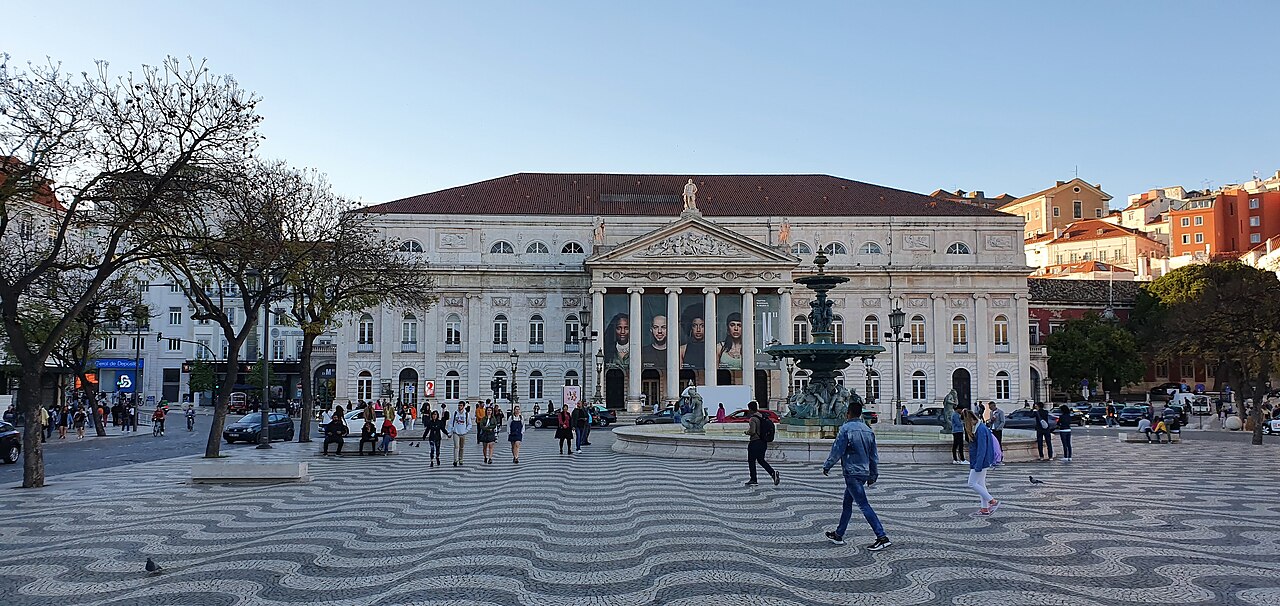
The institution is formed and the Neoclassical theatre rises on the former Estaus Palace site.
 XIAOXIONGMARKETLIS-014 / LISBOA
English
Rossio and Baixa
D. Maria II National Theatre
View the theatre from Rossio square. See how its façade faces the city.
Before entering, confirm opening hours and visiting conditions with the venue.
01 / BUILDING HISTORYFACTS BEFORE INTERPRETATION
The national-theatre idea entered law first,
then acquired a body on Rossio.
In 1836, Passos Manuel and Almeida Garrett advanced the project. Fortunato Lodi's building began in 1842 and opened in 1846. The 1964 fire destroyed most of the interior; the theatre reopened in 1978.
View the full timeline
Fire destroys nearly all of the interior, leaving outer walls and entrance among the surviving parts.
The rebuilt theatre reopens and is later reclassified as a National Monument.
Historical sources and verification
Historical sourcesOfficial heritage register ↗Official institution · history ↗Wikimedia Commons · licences ↗
CITY ANCHOR AUDIT · v1.0
FORMAL ANCHORLIS-014 · FORMAL AUDIT PASSED
Official source
Public heritage, government, archive or responsible-institution records have been checked.
Independent support
At least one separate institutional, professional or academic source corroborates the dossier.
Time and place
Key dates, coordinates and administrative location can be checked against public records.
Facts kept separate
Verified building history is clearly separated from Xiaoxiong's contemporary Eastern reading.
Accountable review
The reviewing team, audit date and next review date are publicly recorded.
02 / WHAT TO LOOK FOR
View the theatre from Rossio square.
See how its façade faces the city.
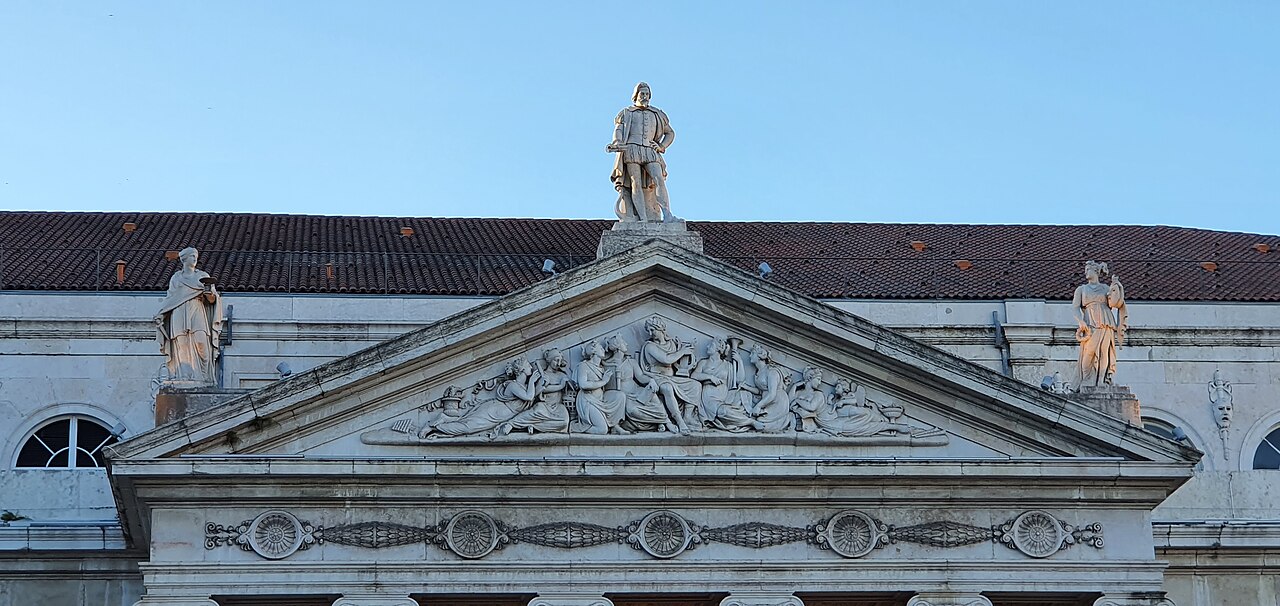
From Rossio, notice how the theatre's façade faces the public square. Compare its exterior with the stories of the fire and reopening. To see inside, first check the current performance or visiting programme.
Light makes the image appear, yet asks us not to mistake it for the whole.
Another perspective on this building
D. Maria II. A light falls on the stage and the square learns to watch together.
Theatre does not escape reality; it places reality in light so strangers can recognise it together.
03 / EASTERN EDITORIAL READING · AN EASTERN WAY OF READING THE CITY
HEXAGRAM 30Hexagram 30LiLi over Li · Fire
Commentary on the Image
“Brightness doubled: Li.”
Continuing light reaches in every direction.
Why do we read this theatre
through Li?
Li is light, image and attachment. Text, actor, stage and audience give public questions visible form.
Explore the interpretationXiaoxiong editorial interpretation
The stage gathers attention
Lighting and framing make everyday conflict visible and discussable.
Art · Illuminate and distinguishThe theatre rests on public institutions
The 1836 framework and 1846 building sustain drama as a continuing public undertaking.
Structure · Find supportAnother light after fire
The 1978 reopening does not erase 1964; it lets collective attention continue.
Time · Light following lightKEEP WALKING WITH THIS HEXAGRAMWhen everyone watches the same play,
When everyone watches the same play,
do we see the characters or ourselves?
Sit on Rossio and notice how the theatre façade organises movement across the square like a stage.
FACT AND INTERPRETATION KEPT SEPARATE
Institutional creation, design, opening, fire and reopening are verifiable facts. Li is a contemporary reading about light, image and public attention.
Loading the restaurant directory within 3 km…
D. Maria II National Theatre · 3 KMAround the landmark,
Around the landmark,
— places to try.
Recognize the entrance. Check the route on the map and the menu on the website.