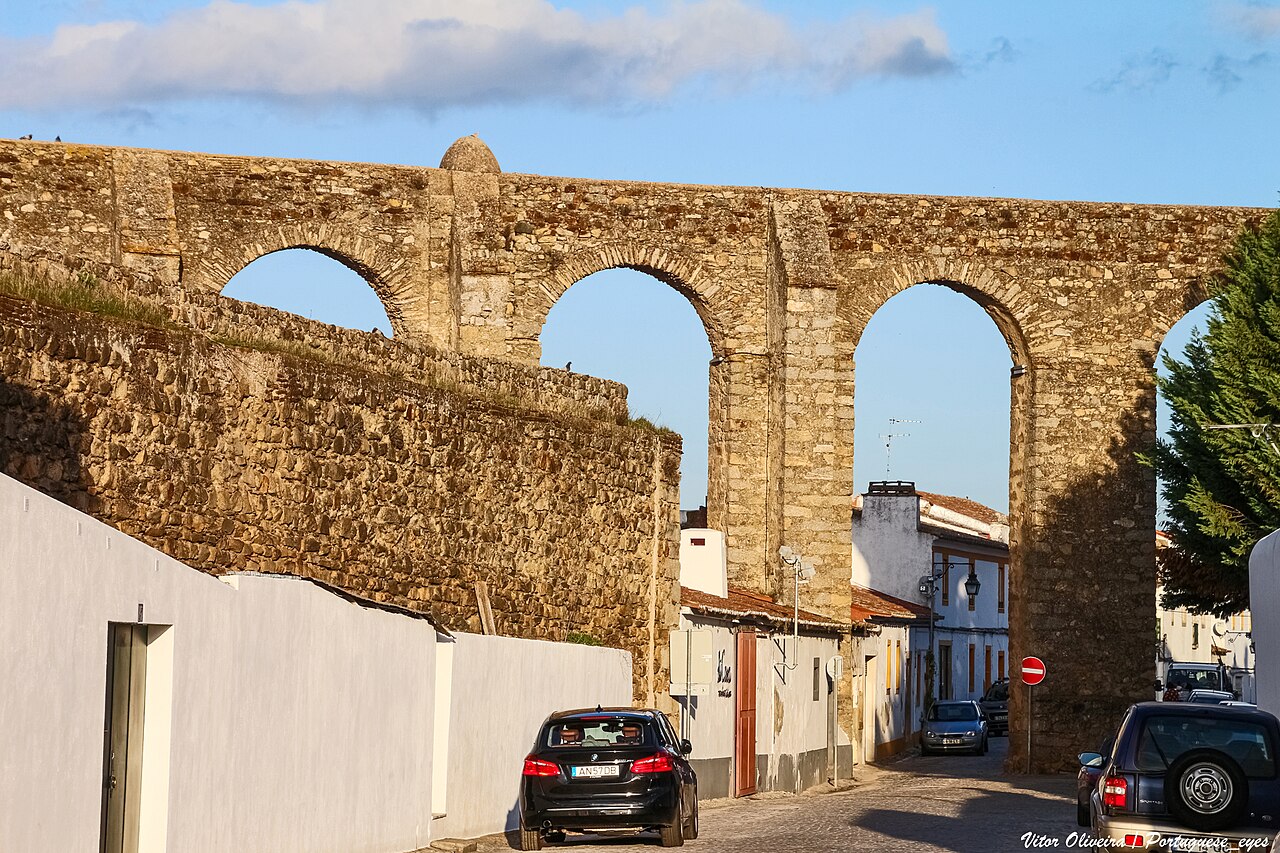
Cropped preview; see the original photograph. The photograph does not confirm the venue’s present condition.
01 / Building stories
Read a building, discover a way of living.
The sixteenth-century aqueduct brought water into Évora from outside. This stop selects an urban section, relating infrastructure to streets and homes without proposing a walk along the entire system.
Notice repeating arches and how they meet the scale of a street. Continuity requires gradient, support and maintenance. Urban life often depends on these quiet connections.
What to notice
Observe from public streets, watching traffic and residential entrances; do not climb arches or enter homes.
Kan offers a way to consider recurring difficulty. Water and terrain do not disappear through willpower; understanding how a problem arises allows action to change. Environment belongs in our judgement.
Start with the architecture
Kan shifts attention from monumental arches to continuity of supply. One failure can affect people far away. Reading the aqueduct means asking who maintains it, who uses it and who bears interruptions.
Bring the question into everyday life
For a recurring difficulty, first record the conditions. Separate steps you can change, help you need and limits to accept for now.
Try an observation here
Pause, record one observed detail and respond to the question below. Notes can hold doubts and different opinions; leave out other people’s private information.
Which overlooked connection supports your everyday life?
A contemporary cultural reading by Xiaoxiong inspired by the I Ching. The connection with the building is an editorial perspective, not the architect’s intention or a documented historical influence. It is not fortune-telling.
03 / Nearby life
A nearby table
Dining map records within three kilometres in a straight line of the reference point. Walls, railways and slopes may lengthen the journey. Check the entrance and whether the business is open.
This selection covers the current municipality. Near hills, rivers and municipal boundaries, plan transport using actual roads.
The map may omit businesses. Records do not confirm trading status, menus or bookings. Records with an address are shown by default; you can include the others.
04 / The travellers’ Bench
Sit for a while. Leave an observation.
Which overlooked connection supports your everyday life?