Entrance: who needs to pass?
The entrance receives visitors and serves daily movement. Stand to one side and watch where people arrive and pause. We read Gen’s stopping as choosing a considerate position: we can observe while others keep working.
FUN-003 / Market and old town
Largo dos Lavradores, Funchal
Dietmar Rabich · CC BY-SA 4.0
Original photograph page ↗Cropped preview; see the original photograph. The photograph does not confirm the venue’s present condition.
01 / Building stories
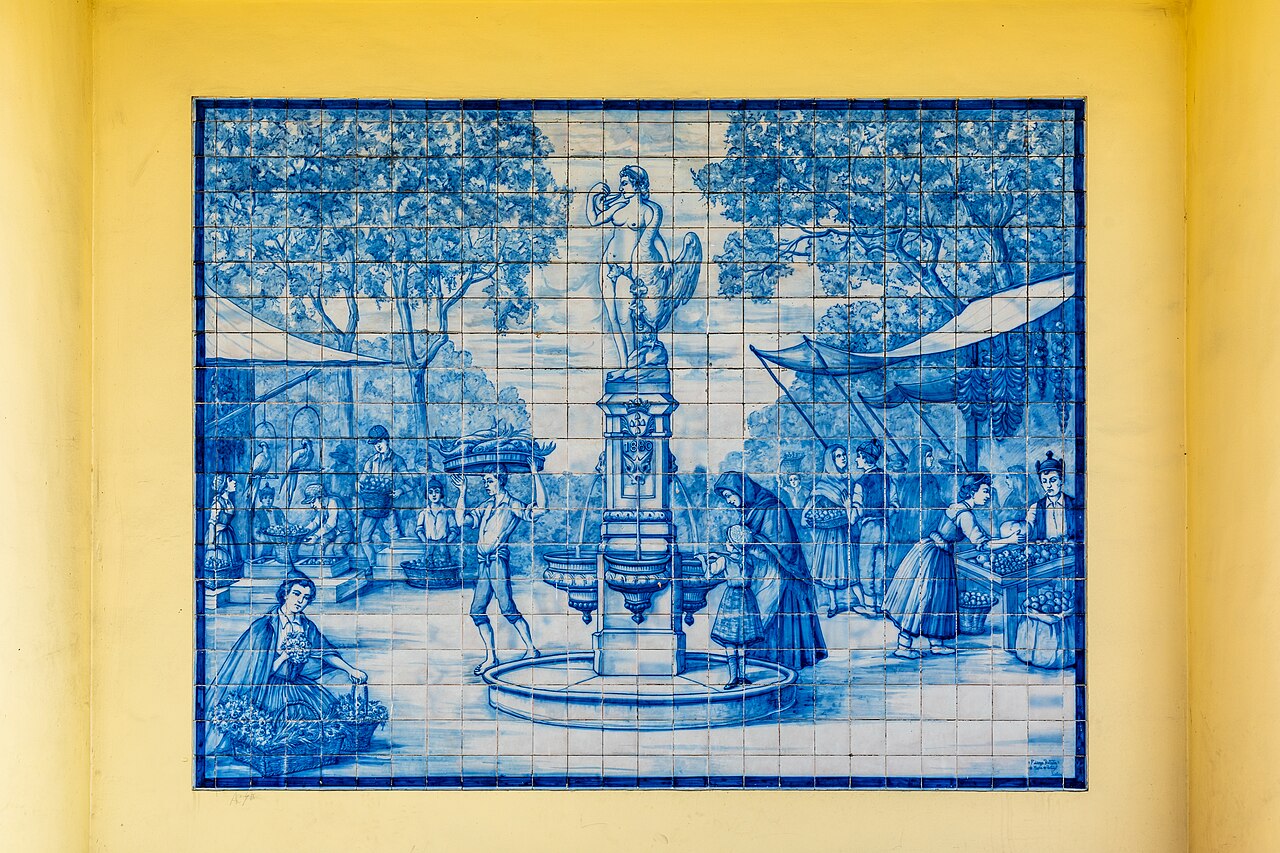
Opened in 1940, Edmundo Tavares’s market links commerce with regional images in tile. Beyond being viewed, it accommodates deliveries, trade and cleaning.
Observe connections between entrance, stalls and fish market. The space depends on people working and visitors making room.
Look at the tile panels and how courtyard, floors and stalls connect. Keep service passages clear and read the market through the movements of people working.
Documentary source ↗02 / I Ching reflections
At the Farmers’ Market, we stay for a little while. Its stalls, passages and courtyard hold a whole working day. This reading of Lü begins with a question: whom does my looking leave room for?
Above · Li · Fire
Below · Gen · Mountain
Read the six lines from bottom to top ↑
Zhou Yi · Commentary on the Image · Lü · Chinese excerpt
山上有火,旅。Fire upon the mountain: Lü, the traveller. — Editorial translation of the excerpt
Original text and context ↗The upper three lines form Li, associated with fire; the lower three form Gen, associated with mountain. Fire’s light and the mountain’s steadiness suggest a temporary stay: seeing takes time to become understanding, and staying requires an awareness of boundaries. Mountain and fire are hexagram images; they do not establish the market’s terrain, materials or design intentions.
The Commentary on the Image introduces fire upon the mountain, then discusses caution in punishment and avoiding prolonged legal proceedings. We retain that context. The connection between attention, care, temporary residence and a market visit is Xiaoxiong’s contemporary interpretation.
The entrance receives visitors and serves daily movement. Stand to one side and watch where people arrive and pause. We read Gen’s stopping as choosing a considerate position: we can observe while others keep working.
The entrance tiles easily become the centre of a photograph. Look at the stalls, floors and courtyard too, noticing how they are used. Li’s clarity reminds us that an image offers a beginning; it cannot speak for the whole market or everyone using it.
Visitors pause; vendors have a day’s work to do. Ask before taking photographs, check prices and units, and leave space for transactions. Keep your own freedom to choose or decline as well. A good visit allows mutual respect.
Take a question to the bench
If you worked here every day, what small change would you ask passing travellers to make?
Go to the bench and note what I saw →A contemporary cultural interpretation by Xiaoxiong. The diagram and excerpt have a source; their connection with the building is an editorial proposal, not the architect’s intention, an established historical influence or the venue’s position.
03 / Nearby life
Dining map records within three kilometres in a straight line of the reference point. Walls, railways and slopes may lengthen the journey. Check the entrance and whether the business is open.
This selection covers the current municipality. Near hills, rivers and municipal boundaries, plan transport using actual roads.
The map may omit businesses. Records do not confirm trading status, menus or bookings. Records with an address are shown by default; you can include the others.
04 / The travellers’ Bench
If you worked here every day, what small change would you ask passing travellers to make?