The hill determines the place
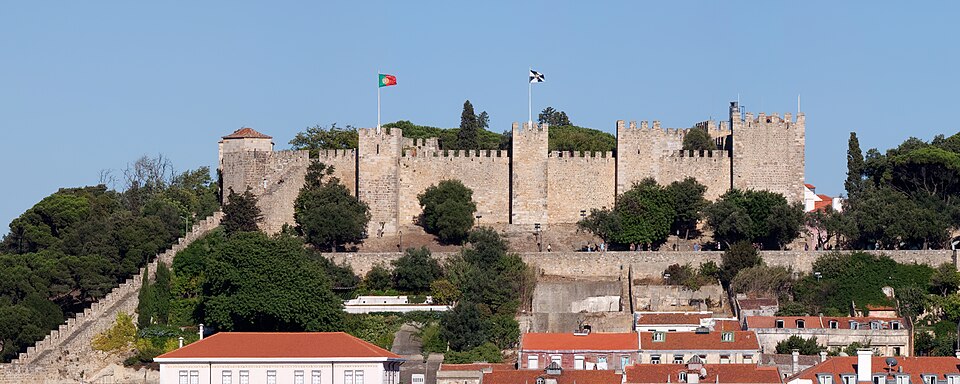
The castle stands on Lisbon's high ground. The hill is not scenery but the beginning of sight, defense and urban direction. First know where you stand; only then can you understand a city.
LIS-001 / Historic centre
Castelo de São Jorge
01 / Building stories
Castle Hill has passed through settlement, rule, defense, earthquake and restoration. We establish the facts and sources first; only then do we tell the story and offer an interpretation.
7th century BCE — A settlement already existed on Castle Hill; the city's story predates today's borders.
11th–12th centuries — The hilltop became a residential and defensive area for Islamic rulers.
1147 — After Lisbon was conquered, the castle became part of the Portuguese Crown's domain.
1755 — The great earthquake devastated the city; the castle and Alfama retained memories of both disaster and continuity.
1910 / 1938–1940 — It was listed as a National Monument in 1910; restoration and clearance in 1938–1940 shaped the castle visible today.
This hillside knew sea winds, armies and migration before today's Lisbon. Walk down from the walls into Alfama and history no longer belongs only to the building: it enters the cobbles, the hanging laundry, the sound of Fado and the small shops still open.
Documentary source ↓02 / I Ching reflections
We are not attaching a hexagram label to a building. We use Gen to ask three questions: Where does it stand? What does it protect? And how does it begin again after stopping?
Above · Gen · Mountain
Below · Gen · Mountain
Read the six lines from bottom to top ↑
Zhou Yi · Commentary on the Image · Chinese excerpt
兼山,艮。Mountains one above another: Gen. — Editorial translation of the excerpt
Original text and context ↗Two mountains bring stopping and limits into view. Gen becomes a judgement: when to continue and when to pause to understand conditions? Acknowledging boundaries can make the next step more deliberate.
This excerpt gives the natural image that opens the Commentary on the Image. The full passage relates it to personal conduct or governance in its historical context. Follow the source to read it in full. Applying it to buildings today is Xiaoxiong’s editorial proposal, not a summary of every meaning of the ancient text.
The castle stands on Lisbon's high ground. The hill is not scenery but the beginning of sight, defense and urban direction. First know where you stand; only then can you understand a city.
The walls separate inside from outside and also constrain power. Gen's “stopping” is not paralysis: it is knowing what must be kept, what must not be crossed and when to pause before deciding.
Earthquake, abandonment and twentieth-century restoration changed the castle repeatedly. True preservation does not reject change; it recognizes within change the core that cannot be lost.
Take a question to the bench
If a city refuses to let anything go, can it still move forward? If it keeps nothing, what allows it to remain itself?
Go to the bench and note what I saw →A contemporary cultural interpretation by Xiaoxiong. The diagram and excerpt have a source; the building connection is editorial, not architectural intent, historical I Ching influence or the venue’s position.
03 / Nearby life
Find a table nearby · filters and directions →
Dining map records within three kilometres in a straight line of the reference point. Walls, railways and slopes may lengthen the journey. Check the entrance and whether the business is open.
The map may omit businesses. Records do not confirm trading status, menus or bookings. Records with an address are shown by default; you can include the others.
04 / The travellers’ Bench
If a city refuses to let anything go, can it still move forward? If it keeps nothing, what allows it to remain itself?
Reviewing team: Xiaoxiong Market · City Editorial Desk · Audit date: 2026-09-19 · Next review: 2027-09-19
Sources consulted: 2026-09-19