Distance enters the centre
The tunnel brings rail to the edge of Rossio and closes the gap between traveller and urban life.
LIS-013 / Historic centre
Estação do Rossio
01 / Building stories
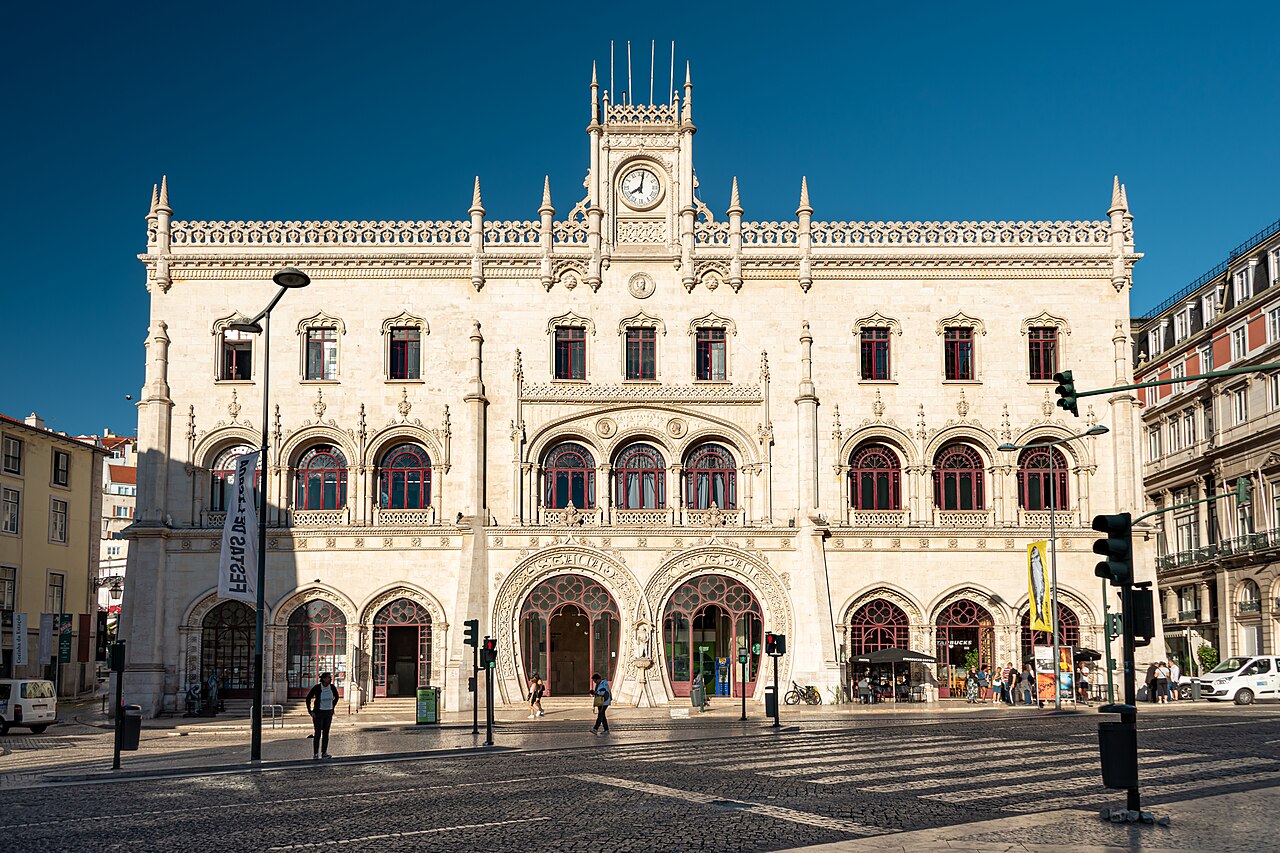
Designed by José Luís Monteiro, construction began in 1886 and the station opened on 11 June 1890. Tunnel, hotel, ramps and station form one ensemble; its Neo-Manueline façade and iron roof bring rail into the city centre.
1886–1890 — Station and tunnel are built; it opens as Lisbon Central Station.
20th century — The royal waiting room, platforms and urban links continue to organise departures and arrivals.
1971–2007 — Public-interest listing is followed by a major contemporary intervention.
Look at the entrance outlines and clock, then consider how the façade relates to the station's function. Follow signs towards the platforms and leave room for passengers. The square is a good place to begin observing the exterior.
Documentary source ↓02 / I Ching reflections
Lü concerns the alertness of being away from home. Rossio gives temporary passage a door, a timetable and a destination.
Above · Li · Fire
Below · Gen · Mountain
Read the six lines from bottom to top ↑
Zhou Yi · Commentary on the Image · Chinese excerpt
山上有火,旅。Fire is upon the mountain: Lü. — Editorial translation of the excerpt
Original text and context ↗A brief stay meets the continuity of local life. Lü brings care to looking: understand conditions of entry, leave room for work and recognise that one visit cannot represent a whole way of life.
This excerpt gives the natural image that opens the Commentary on the Image. The full passage relates it to personal conduct or governance in its historical context. Follow the source to read it in full. Applying it to buildings today is Xiaoxiong’s editorial proposal, not a summary of every meaning of the ancient text.
The tunnel brings rail to the edge of Rossio and closes the gap between traveller and urban life.
Rail turns departure and arrival into time shared with strangers.
Hall, platform and city connection shape urban hospitality.
Take a question to the bench
When a city receives a traveller, does it offer transport alone or a first moment of understanding?
Go to the bench and note what I saw →A contemporary cultural interpretation by Xiaoxiong. The diagram and excerpt have a source; the building connection is editorial, not architectural intent, historical I Ching influence or the venue’s position.
03 / Nearby life
Find a table nearby · filters and directions →
Dining map records within three kilometres in a straight line of the reference point. Walls, railways and slopes may lengthen the journey. Check the entrance and whether the business is open.
The map may omit businesses. Records do not confirm trading status, menus or bookings. Records with an address are shown by default; you can include the others.
04 / The travellers’ Bench
When a city receives a traveller, does it offer transport alone or a first moment of understanding?
Reviewing team: Xiaoxiong Market · City Editorial Desk · Audit date: 2026-09-20 · Next review: 2027-09-20
Jorge Franganillo · CC BY 2.0 · Original photograph page ↗
Cropped preview; see the original photograph. The photograph does not confirm the venue’s present condition.
Sources consulted: 2026-09-20