The stage gathers attention
Lighting and framing make everyday conflict visible and discussable.
LIS-014 / Historic centre
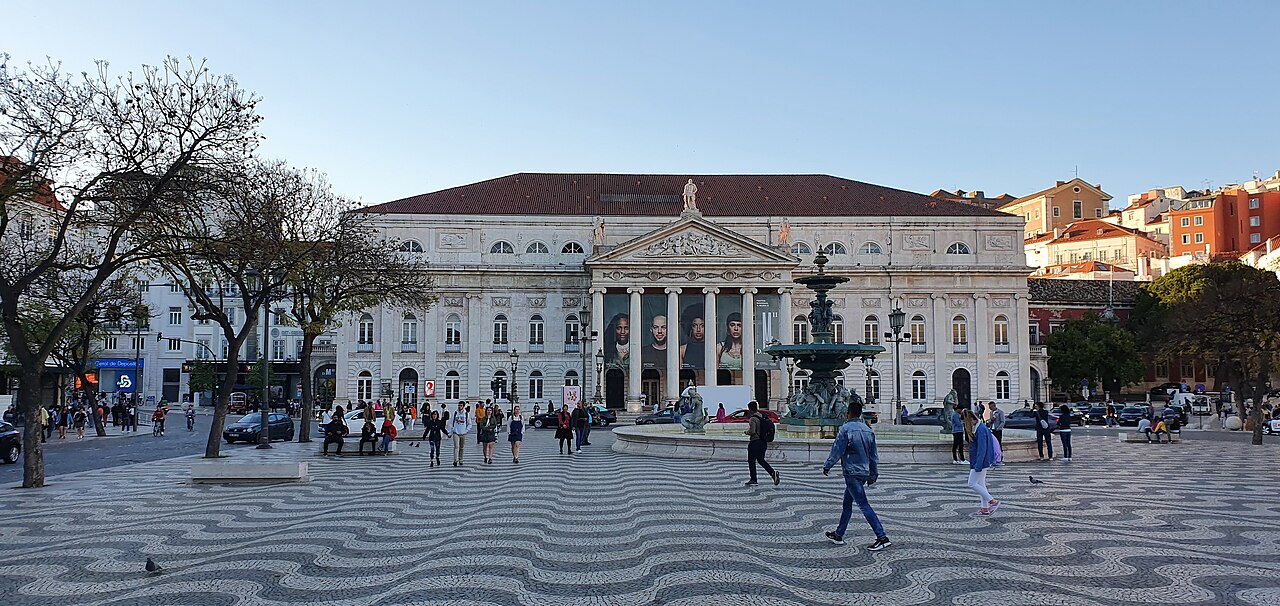
Teatro Nacional D. Maria II
01 / Building stories
In 1836, Passos Manuel and Almeida Garrett advanced the project. Fortunato Lodi's building began in 1842 and opened in 1846. The 1964 fire destroyed most of the interior; the theatre reopened in 1978.
1836–1846 — The institution is formed and the Neoclassical theatre rises on the former Estaus Palace site.
1964 — Fire destroys nearly all of the interior, leaving outer walls and entrance among the surviving parts.
1978–2012 — The rebuilt theatre reopens and is later reclassified as a National Monument.
From Rossio, notice how the theatre's façade faces the public square. Compare its exterior with the stories of the fire and reopening. To see inside, first check the current performance or visiting programme.
Documentary source ↓02 / I Ching reflections
Li is light, image and attachment. Text, actor, stage and audience give public questions visible form.
Above · Li · Fire
Below · Li · Fire
Read the six lines from bottom to top ↑
Zhou Yi · Commentary on the Image · Chinese excerpt
明两作,离。Light rises again: Li. — Editorial translation of the excerpt
Original text and context ↗Two lights rise one after the other. Li suggests attachment: light needs something to rest on before it can illuminate its surroundings. When you see the light, notice also what keeps sustaining it.
This excerpt gives the natural image that opens the Commentary on the Image. The full passage relates it to personal conduct or governance in its historical context. Follow the source to read it in full. Applying it to buildings today is Xiaoxiong’s editorial proposal, not a summary of every meaning of the ancient text.
Lighting and framing make everyday conflict visible and discussable.
The 1836 framework and 1846 building sustain drama as a continuing public undertaking.
The 1978 reopening does not erase 1964; it lets collective attention continue.
Take a question to the bench
When everyone watches the same play, do we see the characters or ourselves?
Go to the bench and note what I saw →A contemporary cultural interpretation by Xiaoxiong. The diagram and excerpt have a source; the building connection is editorial, not architectural intent, historical I Ching influence or the venue’s position.
03 / Nearby life
Find a table nearby · filters and directions →
Dining map records within three kilometres in a straight line of the reference point. Walls, railways and slopes may lengthen the journey. Check the entrance and whether the business is open.
The map may omit businesses. Records do not confirm trading status, menus or bookings. Records with an address are shown by default; you can include the others.
04 / The travellers’ Bench
When everyone watches the same play, do we see the characters or ourselves?
Reviewing team: Xiaoxiong Market · City Editorial Desk · Audit date: 2026-09-20 · Next review: 2027-09-20
Yair Haklai · CC BY-SA 4.0 · Original photograph page ↗
Cropped preview; see the original photograph. The photograph does not confirm the venue’s present condition.
Sources consulted: 2026-09-20