Nearly three centuries of building
Pauses, revisions and restarts give long time a visible architectural form.
LIS-005 / Historic centre
Panteão Nacional
01 / Building stories
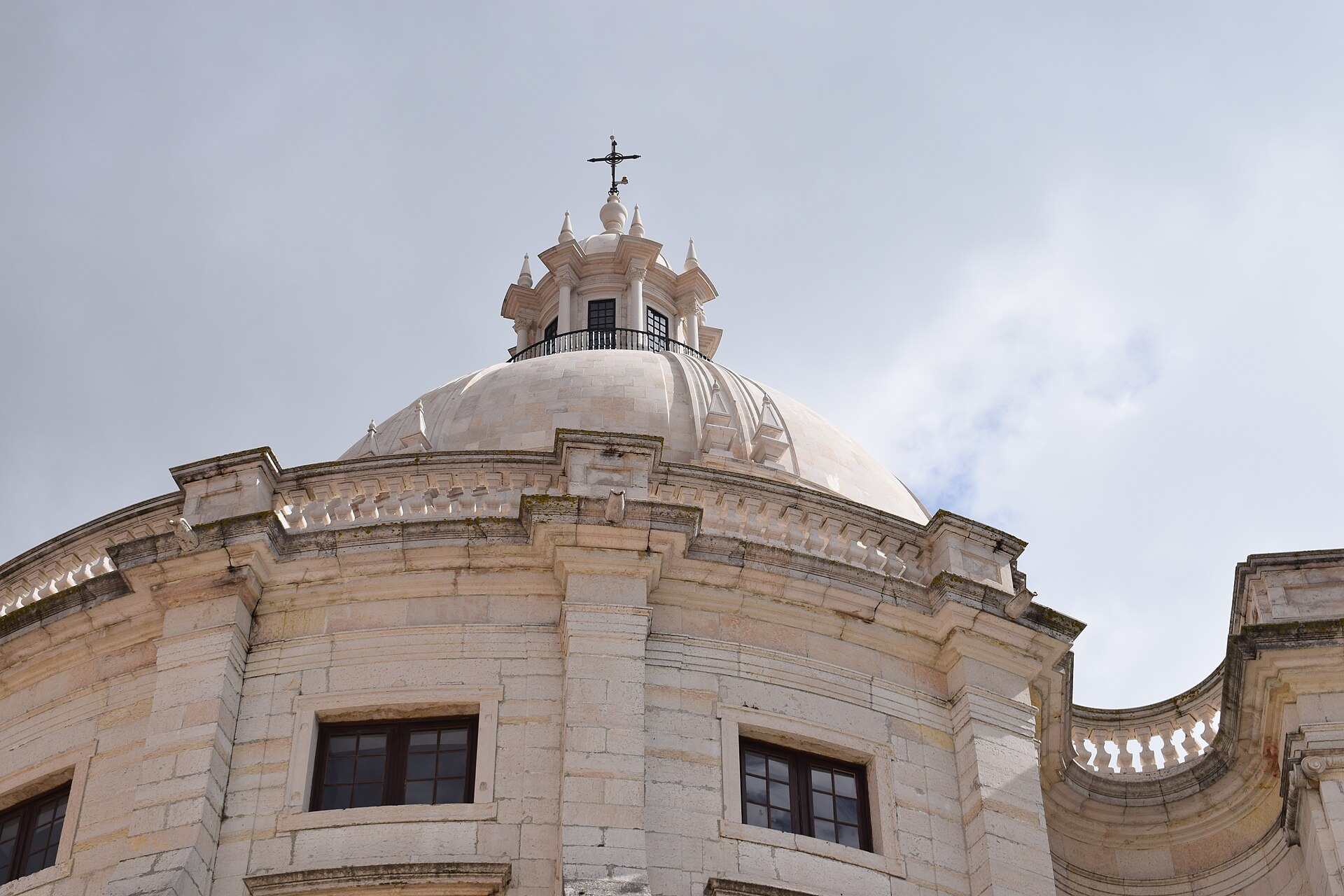
Santa Engrácia passed through early churches, the collapse of 1681, João Antunes's new design, long suspensions and twentieth-century completion, opening as the National Pantheon in 1966.
1568 — A papal brief authorizes the parish of Santa Engrácia and work on the first church follows.
1681–1684 — The church collapses; João Antunes proposes a centralized plan and the new foundation stone is laid.
After 1712 — The architect's death slows progress and ‘the works of Santa Engrácia’ becomes shorthand for something endless.
1916 — Legislation assigns the unfinished church a new role as the National Pantheon.
1966 — The dome and building are completed; the Pantheon opens on 7 December.
Start with the dome and exterior silhouette, then notice how the memorial spaces are arranged inside. Compare the completed building with its timeline to understand how many generations the project spanned. Check opening arrangements before entering.
Documentary source ↓02 / I Ching reflections
Heng is not rigid repetition. It is keeping direction through prolonged change. Santa Engrácia made incompletion part of Lisbon's shared memory of patience.
Above · Zhen · Thunder
Below · Xun · Wind / wood
Read the six lines from bottom to top ↑
Zhou Yi · Commentary on the Image · Chinese excerpt
雷风,恒。Thunder and wind: Heng. — Editorial translation of the excerpt
Original text and context ↗Continuity needs direction and adaptation. Heng does not make every day identical. Maintenance, repeated use and small adjustments help reveal what deserves to continue and what needs to change.
This excerpt gives the natural image that opens the Commentary on the Image. The full passage relates it to personal conduct or governance in its historical context. Follow the source to read it in full. Applying it to buildings today is Xiaoxiong’s editorial proposal, not a summary of every meaning of the ancient text.
Pauses, revisions and restarts give long time a visible architectural form.
From church to national memorial, constancy is not immobility but asking again why the work should continue.
The Pantheon places individual lives within a common story and keeps debate about remembrance alive.
Take a question to the bench
When something lasts a long time, is it inertia, or does each generation decide it is still worth continuing?
Go to the bench and note what I saw →A contemporary cultural interpretation by Xiaoxiong. The diagram and excerpt have a source; the building connection is editorial, not architectural intent, historical I Ching influence or the venue’s position.
03 / Nearby life
Find a table nearby · filters and directions →
Dining map records within three kilometres in a straight line of the reference point. Walls, railways and slopes may lengthen the journey. Check the entrance and whether the business is open.
The map may omit businesses. Records do not confirm trading status, menus or bookings. Records with an address are shown by default; you can include the others.
04 / The travellers’ Bench
When something lasts a long time, is it inertia, or does each generation decide it is still worth continuing?
Reviewing team: Xiaoxiong Market · City Editorial Desk · Audit date: 2026-09-20 · Next review: 2027-09-20
AntoineJoub · CC BY-SA 4.0 · Original photograph page ↗
Cropped preview; see the original photograph. The photograph does not confirm the venue’s present condition.
Sources consulted: 2026-09-20