Rail sets the city travelling
The 1856 line places Lisbon within a new speed and a national network.
LIS-008 / Historic centre
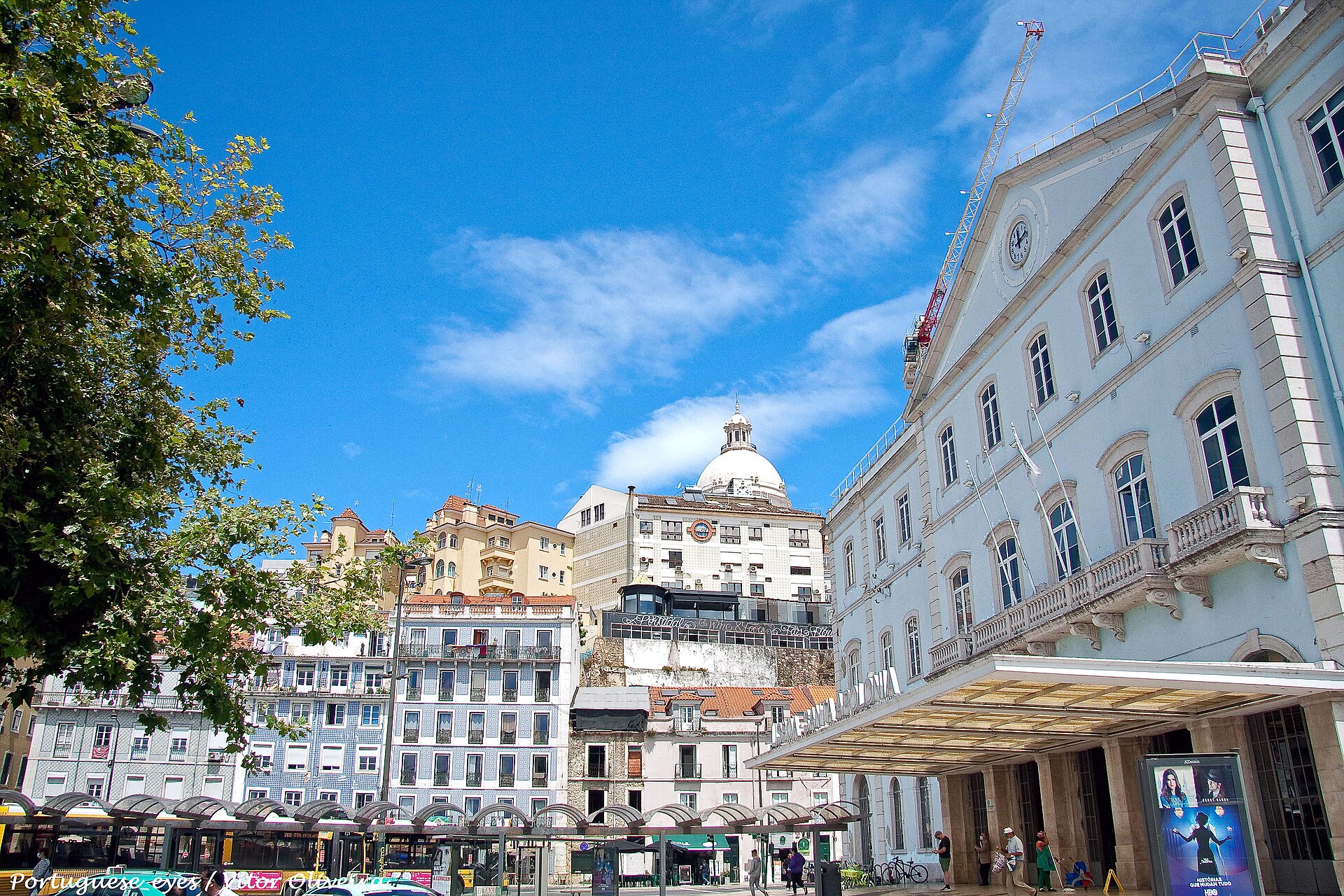
Estação de Santa Apolónia
01 / Building stories
Portugal's first railway section left this area for Carregado in 1856. The present station was approved in 1862 and opened in 1865. Additional floors, electrification and the metro later reshaped its role.
1856 — Portugal's first railway links Lisbon with Carregado, using temporary facilities in the former Santa Apolónia convent.
1862 — The permanent station design is approved, prepared by a team of engineers and built by a French company.
1865 — The present station opens on 1 May as a terminus for the North and East lines.
Early 20th century — Another floor is added and the building adapts to railway administration and growing passenger services.
1950s–2007 — Long-distance trains return; the 2007 metro connection joins the national network to urban transport.
Start with the façade and entrance, then observe how passengers move between the street, waiting areas and platforms. Keep circulation routes clear. For travel information, use the station's current departure boards.
Documentary source ↓02 / I Ching reflections
Zhen is disruption and beginning. Railway sound changed how distance was understood; the point is not noise itself, but how direction is adjusted afterwards.
Above · Zhen · Thunder
Below · Zhen · Thunder
Read the six lines from bottom to top ↑
Zhou Yi · Commentary on the Image · Chinese excerpt
洊雷,震。Repeated thunder: Zhen. — Editorial translation of the excerpt
Original text and context ↗Thunder sounds again and again. Zhen looks at the response after a shock: when startled, is there panic, or a renewed look at oneself and one’s surroundings? A sudden change can also lead to clearer action.
This excerpt gives the natural image that opens the Commentary on the Image. The full passage relates it to personal conduct or governance in its historical context. Follow the source to read it in full. Applying it to buildings today is Xiaoxiong’s editorial proposal, not a summary of every meaning of the ancient text.
The 1856 line places Lisbon within a new speed and a national network.
Whistles, timetables and platforms turn distance into calculated departures and arrivals.
Across rail, long-distance services and metro, the station repeatedly revises how the city connects.
Take a question to the bench
As speed increases, do we still know why we are leaving?
Go to the bench and note what I saw →A contemporary cultural interpretation by Xiaoxiong. The diagram and excerpt have a source; the building connection is editorial, not architectural intent, historical I Ching influence or the venue’s position.
03 / Nearby life
Find a table nearby · filters and directions →
Dining map records within three kilometres in a straight line of the reference point. Walls, railways and slopes may lengthen the journey. Check the entrance and whether the business is open.
The map may omit businesses. Records do not confirm trading status, menus or bookings. Records with an address are shown by default; you can include the others.
04 / The travellers’ Bench
As speed increases, do we still know why we are leaving?
Reviewing team: Xiaoxiong Market · City Editorial Desk · Audit date: 2026-09-20 · Next review: 2027-09-20
Vitor Oliveira · CC BY-SA 2.0 · Original photograph page ↗
Cropped preview; see the original photograph. The photograph does not confirm the venue’s present condition.
Sources consulted: 2026-09-20