Many identities, one place
Monastery, royal pantheon, patriarchal palace and museum overlap; abundance becomes a public trust.
LIS-004 / Historic centre
Mosteiro de São Vicente de Fora
01 / Building stories
Founded by Afonso Henriques in 1147, the medieval monastery was replaced by the monumental rebuilding of the sixteenth and seventeenth centuries. It later became an episcopal palace, royal pantheon and place of public memory.
1147 — Afonso Henriques founds the monastery after Lisbon's conquest and entrusts it to Augustinian canons.
1210 — Saint Anthony of Lisbon professes here before moving to Coimbra.
1582–1629 — The old complex gives way to the monumental building associated with Filippo Terzi and other masters.
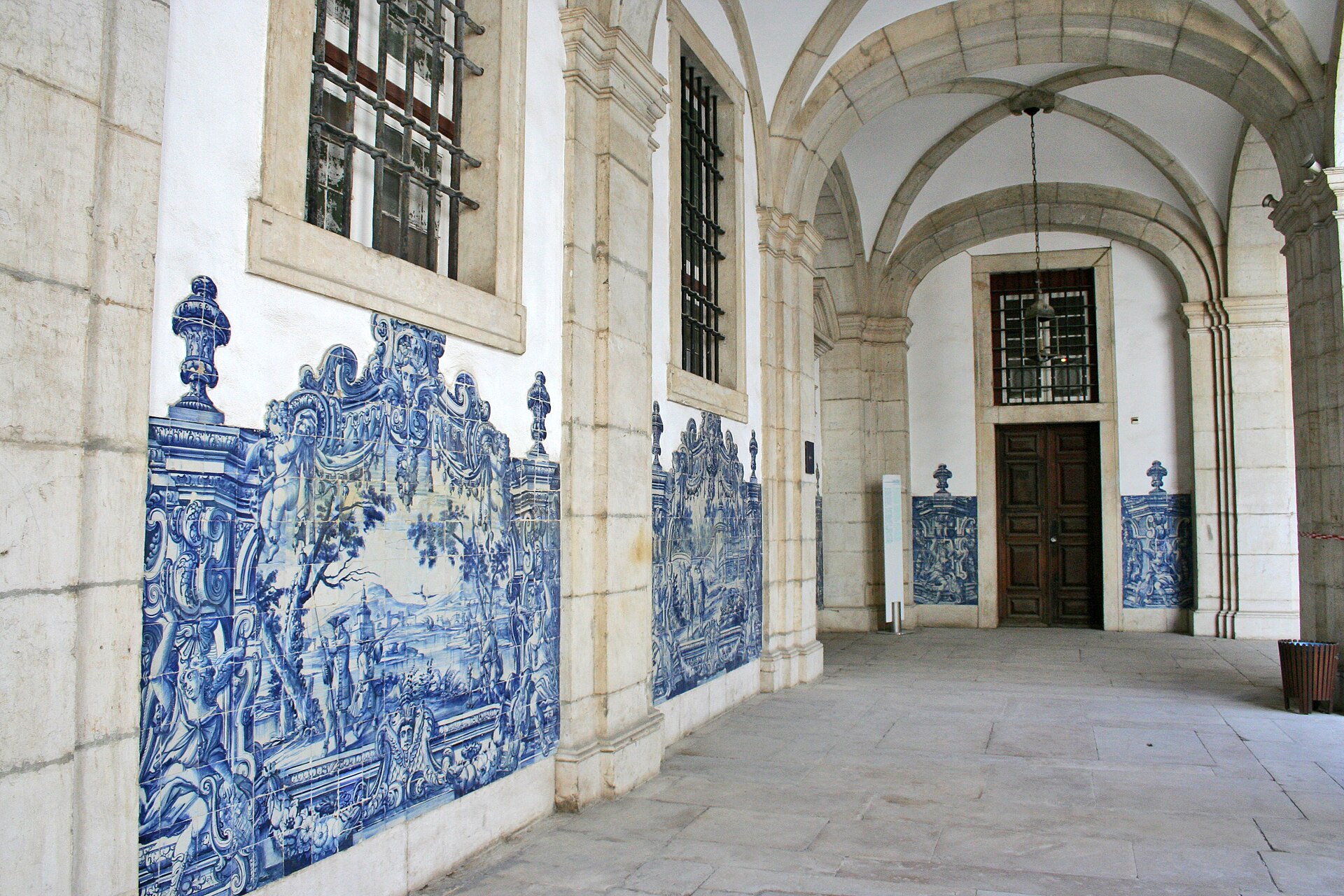
18th century — Cloisters and rooms receive extensive azulejo cycles, turning walls into visual narrative.
1834–today — After the religious orders are dissolved, it becomes an episcopal palace and keeps the Braganza and Patriarchal pantheons.
Look at the cloister, tiles and tombs separately: first notice how the spaces connect, then the images on the walls, and finally the tomb labels. They belong to one monastery but record uses from different periods.
Documentary source ↓02 / I Ching reflections
Da You does not glorify possession. It asks how to choose, order and transmit when much has been entrusted to us.
Above · Li · Fire
Below · Qian · Heaven
Read the six lines from bottom to top ↑
Zhou Yi · Commentary on the Image · Chinese excerpt
火在天上,大有。Fire is in the sky: Da You. — Editorial translation of the excerpt
Original text and context ↗Light and abundance raise questions about the use of resources. With collections, palaces or monuments, Da You takes us from how much exists to who has access and who cares for it.
This excerpt gives the natural image that opens the Commentary on the Image. The full passage relates it to personal conduct or governance in its historical context. Follow the source to read it in full. Applying it to buildings today is Xiaoxiong’s editorial proposal, not a summary of every meaning of the ancient text.
Monastery, royal pantheon, patriarchal palace and museum overlap; abundance becomes a public trust.
Azulejos, tombs and records gain meaning only when their origin, period and purpose remain clear.
What is kept stays alive only when it can be read, discussed and shared again.
Take a question to the bench
If a city holds so much heritage, does it also owe everyone the means to understand it?
Go to the bench and note what I saw →A contemporary cultural interpretation by Xiaoxiong. The diagram and excerpt have a source; the building connection is editorial, not architectural intent, historical I Ching influence or the venue’s position.
03 / Nearby life
Find a table nearby · filters and directions →
Dining map records within three kilometres in a straight line of the reference point. Walls, railways and slopes may lengthen the journey. Check the entrance and whether the business is open.
The map may omit businesses. Records do not confirm trading status, menus or bookings. Records with an address are shown by default; you can include the others.
04 / The travellers’ Bench
If a city holds so much heritage, does it also owe everyone the means to understand it?
Reviewing team: Xiaoxiong Market · City Editorial Desk · Audit date: 2026-09-20 · Next review: 2027-09-20
Alegna13 · CC BY-SA 3.0 · Original photograph page ↗
Cropped preview; see the original photograph. The photograph does not confirm the venue’s present condition.
Sources consulted: 2026-09-20