Clues in the space
Kan shifts attention from monumental arches to continuity of supply. One failure can affect people far away. Reading the aqueduct means asking who maintains it, who uses it and who bears interruptions.
Parte del contenido está en inglés.Leer el original en portugués →
EVO-006 / Squares and water
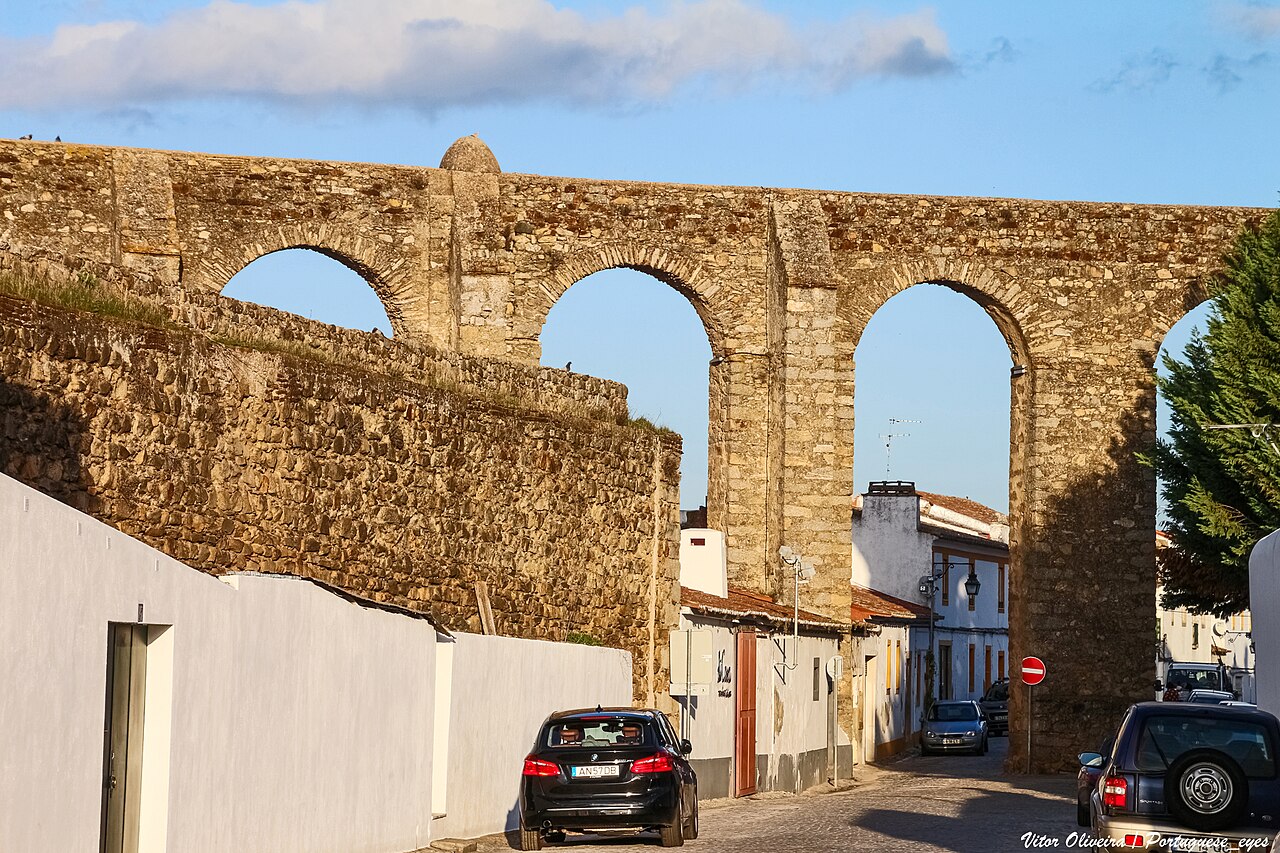
Aqueduto da Água da Prata — troço urbano
Rua do Cano, Évora
01 / Historias de edificios
The sixteenth-century aqueduct brought water into Évora from outside. This stop selects an urban section, relating infrastructure to streets and homes without proposing a walk along the entire system.
Notice repeating arches and how they meet the scale of a street. Continuity requires gradient, support and maintenance. Urban life often depends on these quiet connections.
Observe from public streets, watching traffic and residential entrances; do not climb arches or enter homes.
Fuente ↓02 / I Ching reflections
Kan offers a way to consider recurring difficulty. Water and terrain do not disappear through willpower; understanding how a problem arises allows action to change. Environment belongs in our judgement.
Above · Kan · Water
Below · Kan · Water
Read the six lines from bottom to top ↑
Zhou Yi · Commentary on the Image · Chinese excerpt
水洊至,习坎。Water arrives again and again: Kan. — Editorial translation of the excerpt
Original text and context ↗Recurring water suggests risk and learning. Kan invites attention to real conditions, existing protections and what remains unknown before choosing a feasible next step.
This excerpt gives the natural image that opens the Commentary on the Image. The full passage relates it to personal conduct or governance in its historical context. Follow the source to read it in full. Applying it to buildings today is Xiaoxiong’s editorial proposal, not a summary of every meaning of the ancient text.
Kan shifts attention from monumental arches to continuity of supply. One failure can affect people far away. Reading the aqueduct means asking who maintains it, who uses it and who bears interruptions.
Observe from public streets, watching traffic and residential entrances; do not climb arches or enter homes.
For a recurring difficulty, first record the conditions. Separate steps you can change, help you need and limits to accept for now.
Take a question to the bench
Which overlooked connection supports your everyday life?
Go to the bench and note what I saw →A contemporary cultural interpretation by Xiaoxiong. The diagram and excerpt have a source; the building connection is editorial, not architectural intent, historical I Ching influence or the venue’s position.
03 / Vida del barrio
Abrir mesas cercanas · filtros y cómo llegar →
Locales a tres kilómetros en línea recta del edificio. Muros, vías y pendientes pueden alargar el recorrido; comprueba la entrada y si el local está abierto.
Comprobando la red Banco y las reclamaciones…
Esta selección abarca el municipio actual. Planifica el trayecto por carreteras y caminos reales.
El directorio puede tener omisiones. Los registros no confirman apertura, carta ni reservas. Se muestran primero las direcciones completas.
04 / El Banco
Which overlooked connection supports your everyday life?
Vitor Oliveira from Torres Vedras, PORTUGAL · CC BY-SA 2.0 · Ver la fotografía original ↗
La presentación puede recortar la imagen. Consulta el original. La foto no representa el estado actual del lugar.
Consultado: 2026-10-23