Clues in the space
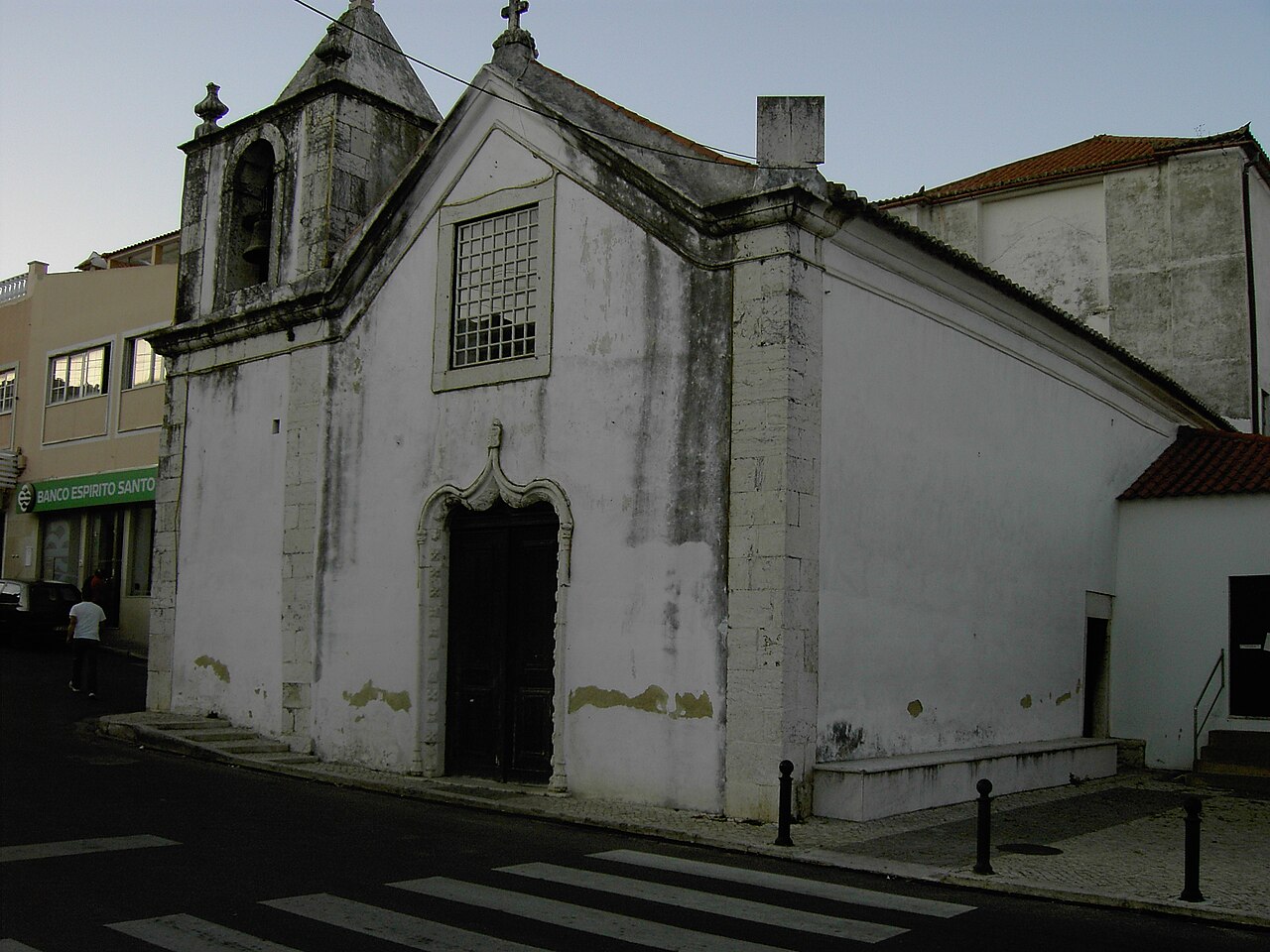
Portal, ceiling, tiles and painting belong to different materials and phases. Choose two details to compare. When the church is closed, the entrance stonework still offers a history worth noticing.
Parte del contenido está en inglés.Leer el original en portugués →
ODI-007 / Eastern neighbourhoods and Póvoa
Largo Major Rosa Bastos, 31, 2620-471 Póvoa de Santo Adrião
01 / Historias de edificios
The Manueline portal points to construction in the early sixteenth century. Later works added layers to the interior: green-and-white tiles, a timber ceiling and altar decoration make it a space accumulated over time.
According to the heritage record, Pedro Alexandrino painted the high altar’s Last Supper in 1802. He lived nearby. Reading the entrance stonework alongside the interior painting reveals how a neighbourhood continually renews a shared place. Check opening and worship arrangements first.
Begin with the portal’s curves and the tower’s position. If the interior is open, relate a tile panel to a painting without disturbing worship.
Fuente ↓02 / I Ching reflections
Jian helps us recognise accumulation. Works of different periods coexist because repeated additions changed a common space. Everyday growth can take a similar form.
Above · Xun · Wind / wood
Below · Gen · Mountain
Read the six lines from bottom to top ↑
Zhou Yi · Commentary on the Image · Chinese excerpt
山上有木,渐。Wood grows upon the mountain: Jian. — Editorial translation of the excerpt
Original text and context ↗A tree’s growth depends on time and roots. Jian makes habits, craft and maintenance observable processes. Slowness does not guarantee a sound direction; that direction needs review.
This excerpt gives the natural image that opens the Commentary on the Image. The full passage relates it to personal conduct or governance in its historical context. Follow the source to read it in full. Applying it to buildings today is Xiaoxiong’s editorial proposal, not a summary of every meaning of the ancient text.
Portal, ceiling, tiles and painting belong to different materials and phases. Choose two details to compare. When the church is closed, the entrance stonework still offers a history worth noticing.
Begin with the portal’s curves and the tower’s position. If the interior is open, relate a tile panel to a painting without disturbing worship.
Lasting change involves repetition and adjustment. Try reading one page of local history each week or recording a street detail. Returning to early notes may reveal understanding that has grown slowly.
Take a question to the bench
Which long-standing small habit is gradually changing your life?
Go to the bench and note what I saw →A contemporary cultural interpretation by Xiaoxiong. The diagram and excerpt have a source; the building connection is editorial, not architectural intent, historical I Ching influence or the venue’s position.
03 / Vida del barrio
Abrir mesas cercanas · filtros y cómo llegar →
Locales a tres kilómetros en línea recta del edificio. Muros, vías y pendientes pueden alargar el recorrido; comprueba la entrada y si el local está abierto.
Comprobando la red Banco y las reclamaciones…
El directorio puede tener omisiones. Los registros no confirman apertura, carta ni reservas. Se muestran primero las direcciones completas.
04 / El Banco
Which long-standing small habit is gradually changing your life?
Hipersyl · CC BY-SA 3.0 · Ver la fotografía original ↗
La presentación puede recortar la imagen. Consulta el original. La foto no representa el estado actual del lugar.
Consultado: 2026-10-21