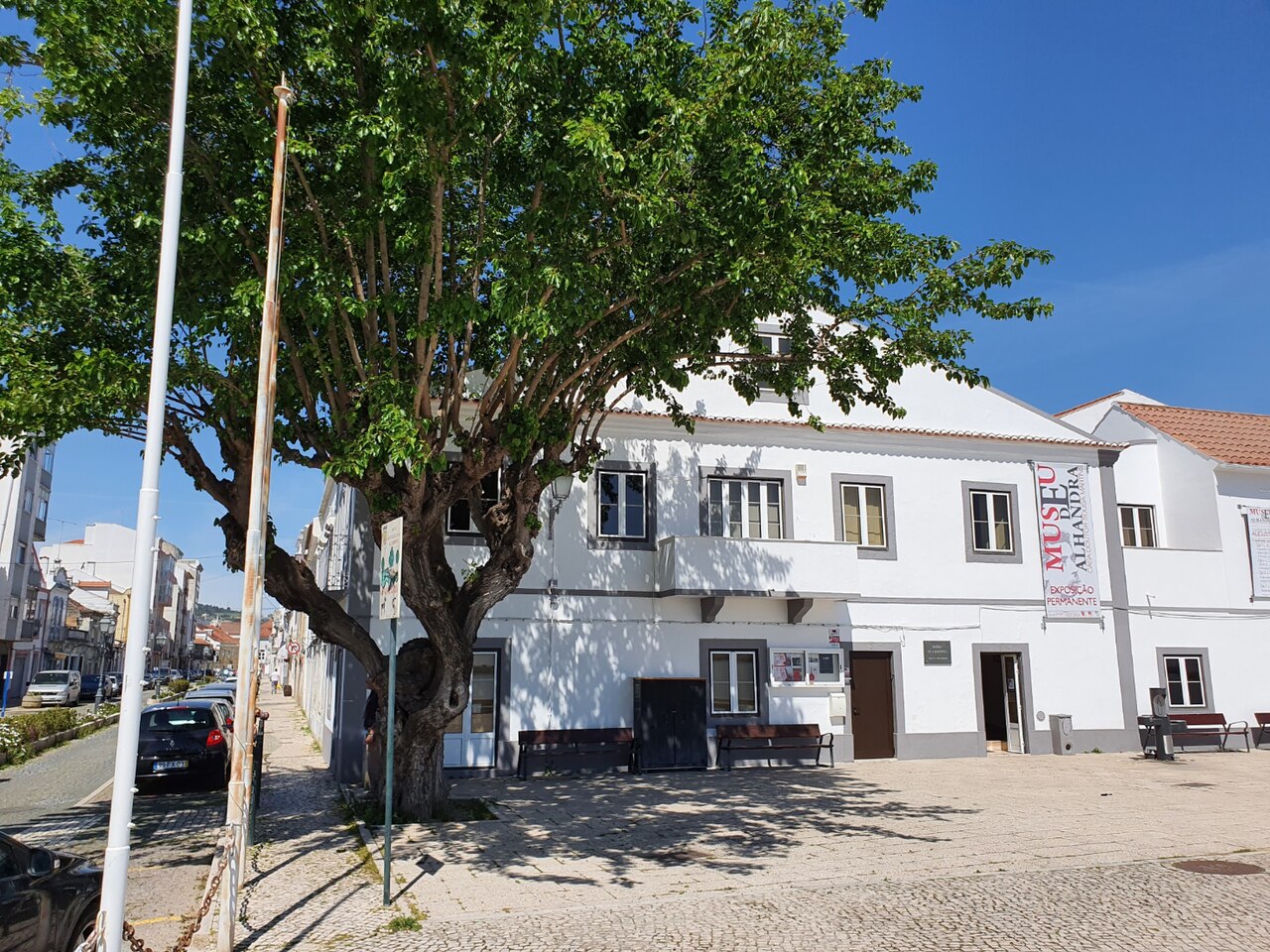
Cropped preview; see the original photograph. The photograph does not confirm the venue’s present condition.
01 / Building stories
Read a building, discover a way of living.
Opened on 3 March 1985, the museum tells Alhandra’s story through documents, photographs, working tools and everyday objects. Memories of Sousa Martins meet local industry, associations and sport, making a house an entry point to a wider community.
Begin with the building’s relationship to Largo do Cais. In an open gallery, choose an ordinary object: who used it, how did it enter the collection, and what information makes it understandable? These questions take a visit beyond recognising a famous name.
The church on the hillside offers another view of Alhandra. Plan the climb and return separately according to your mobility and available transport.
What to notice
Relate the house to the riverside square, then choose a working tool and consider its user.
Shared memory needs collecting and room for different voices. An ordinary object can reveal a life overlooked by larger narratives.
Start with the architecture
The scale of a house brings a visit close to everyday life. Notice cases, passages and windows: where can you read slowly, and where should you leave room?
Bring the question into everyday life
Cui is an editorial question about gathering and shared life. Collecting also means explaining origins and admitting gaps. Whose memories are most easily lost in your family or street?
Try an observation here
Note an object’s use and provenance, plus one question its label leaves unanswered.
Which ordinary object would you use to introduce a place you have lived?
A contemporary cultural reading by Xiaoxiong inspired by the I Ching. The connection with the building is an editorial perspective, not the architect’s intention or a documented historical influence. It is not fortune-telling.
03 / Nearby life
A nearby table
Dining map records within three kilometres in a straight line of the reference point. Walls, railways and slopes may lengthen the journey. Check the entrance and whether the business is open.
The map may omit businesses. Records do not confirm trading status, menus or bookings. Records with an address are shown by default; you can include the others.
04 / The travellers’ Bench
Sit for a while. Leave an observation.
Which ordinary object would you use to introduce a place you have lived?