Clues in the space
Panels, gestures and inscriptions form a reading sequence. Look at one image alone, then at its neighbours: how does the same action acquire a different meaning? The monument is also evidence of how a story was presented.
Parte del contenido está en inglés.Leer el original en portugués →
ODI-006 / Eastern neighbourhoods and Póvoa
Rua do Senhor Roubado / Rua Pedro Álvares Cabral, Odivelas
01 / Historias de edificios
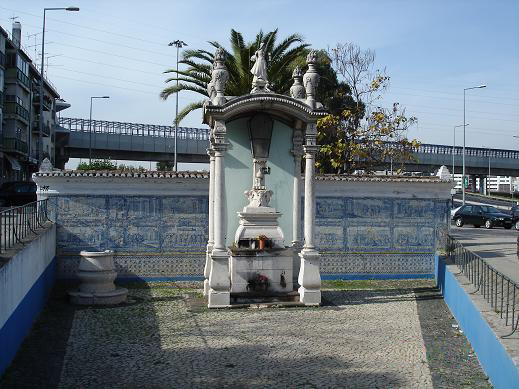
The memorial was constructed in stages between 1744 and 1747. Blue-and-white tile panels recount a theft of sacred objects in 1671 and the trial that followed. The heritage record distinguishes building and tiling campaigns; inscriptions must be read alongside later alterations.
The images reveal streets, clothing and actions, but also express the religious and political perspectives of their time. A story placed in public space shapes later memory. We can study its narrative methods while reflecting critically on the severe punishments represented.
From a safe public stopping place, follow the panels’ sequence. Distinguish the visual account from verified events and do not touch the tiles.
Fuente ↓02 / I Ching reflections
Song invites reflection on conflict, judgement and evidence. Repetition does not mean every voice has survived. Give an emotionally powerful story time for verification.
Above · Qian · Heaven
Below · Kan · Water
Read the six lines from bottom to top ↑
Zhou Yi · Commentary on the Image · Chinese excerpt
天与水违行,讼。Heaven and water move in different directions: Song. — Editorial translation of the excerpt
Original text and context ↗Different directions can bring disagreement. Song invites clear conditions and responsibilities from the outset, with room to listen and revise. A building’s boundaries can prompt us to ask whose voice is heard.
This excerpt gives the natural image that opens the Commentary on the Image. The full passage relates it to personal conduct or governance in its historical context. Follow the source to read it in full. Applying it to buildings today is Xiaoxiong’s editorial proposal, not a summary of every meaning of the ancient text.
Panels, gestures and inscriptions form a reading sequence. Look at one image alone, then at its neighbours: how does the same action acquire a different meaning? The monument is also evidence of how a story was presented.
From a safe public stopping place, follow the panels’ sequence. Distinguish the visual account from verified events and do not touch the tiles.
Separate evidence, the narrator’s position and your own emotion. Before responding to conflict, clarify what happened and whose experience has not been heard. A compelling narrative deserves examination as well as a reaction.
Take a question to the bench
What do you check first when a news story makes you immediately angry?
Go to the bench and note what I saw →A contemporary cultural interpretation by Xiaoxiong. The diagram and excerpt have a source; the building connection is editorial, not architectural intent, historical I Ching influence or the venue’s position.
03 / Vida del barrio
Abrir mesas cercanas · filtros y cómo llegar →
Locales a tres kilómetros en línea recta del edificio. Muros, vías y pendientes pueden alargar el recorrido; comprueba la entrada y si el local está abierto.
Comprobando la red Banco y las reclamaciones…
El directorio puede tener omisiones. Los registros no confirman apertura, carta ni reservas. Se muestran primero las direcciones completas.
04 / El Banco
What do you check first when a news story makes you immediately angry?
Lmcadete · Public domain · Ver la fotografía original ↗
La presentación puede recortar la imagen. Consulta el original. La foto no representa el estado actual del lugar.
Consultado: 2026-10-21